
C & T Newsletters
May 2025
Google Leads Global Surge in AI Patents as Focus Shifts to Agentic Technologies
Takeaway: Google is leading the surge in AI patent filings globally and in the U.S., particularly in emerging areas like agentic AI, underscoring its investment in next-generation autonomous technologies as the AI patent landscape continues to grow rapidly.

A new report from IFI Claims Patent Services shows that Google is leading the global race in artificial intelligence patent filings, outpacing competitors such as Microsoft, IBM, and Samsung, with 1,837 AI-related applications filed globally with 880 of them having been submitted to the U.S. Patent and Trademark Office. Over the past decade, AI patent grants have increased at a compound annual rate of 38 percent, while applications have grown by 31 percent, reflecting rapid innovation in the field.
The report highlights growing interest in agentic AI, a subset of artificial intelligence that enables autonomous software agents to perform tasks and make decisions with minimal human input. Google also leads in filings for agentic AI patents, followed by Nvidia, although this segment remains relatively small, accounting for 5 percent of global AI patent filings and 7 percent in the United States. The report further notes an overall resurgence in U.S. patent activity, with more than 430,000 applications filed in 2024, signaling renewed momentum in technology development.
Navigating the New EU Design Laws
Takeaway: The EU’s updated design laws now offer broader protection for digital and animated content while streamlining filing processes, making it essential to secure your design rights.

The European Union is rolling out significant reforms to its design protection laws in two phases, starting May 1, 2025, with additional changes coming in July 2026. These updates modernize the legal framework to include digital and animated designs, such as user interfaces, motion graphics, and logos, providing broader protection for businesses in the digital economy. Companies can now file up to 50 designs in a single application, reducing administrative costs and encouraging more comprehensive IP strategies.
Terminology updates, such as replacing “community design” with “EU design,” aim to align legal language across the EU. New rules also clarify fair use exceptions for education, parody, and interoperability, while expanding enforcement options against counterfeit goods in transit. Notably, the reforms introduce a repair clause that limits design rights on spare parts used to restore a product’s original appearance, and new cultural heritage protections may impact the registrability of certain symbols.
These changes create valuable new opportunities—and potential risks—for businesses operating in the EU. It is crucial to review and strengthen your design protection strategy now.
USPTO Seeks Public Input on Global Guidelines to Fight Online Counterfeit Trade
Takeaway: The USPTO is seeking public input on international draft guidelines to combat the $467 billion global trade in counterfeit goods sold online, noting the urgent need for coordinated enforcement and collaboration between governments, platforms, and IP holders to protect consumers and brand integrity.

The U.S. Patent and Trademark Office (USPTO) has published a request for public comments on draft guidelines aimed at combating the sale of counterfeit goods online, as part of a global initiative led by the Organisation for Economic Co-operation and Development (OECD). These “Draft Voluntary Guidelines for Countering Illicit Trade in Counterfeit Goods on Online Marketplaces” address key areas such as enforcement, sanctions, repeat infringers, transparency, international cooperation, and public awareness.
The USPTO will host a public hearing on June 5 in Washington, D.C., to facilitate dialogue between intellectual property rights holders, online marketplaces, and other stakeholders, with written comments accepted until June 27. The OECD’s initiative follows a report showing the global counterfeit trade reached $467 billion in 2021, with clothing, footwear, and leather goods being the most affected categories. China and Hong Kong were identified as the leading sources of counterfeit products. The OECD’s project is structured in three phases: identifying the problem, developing policy recommendations, and fostering public-private dialogue, with the upcoming hearing marking the start of the third phase.
Recent legal action, including the NBA’s lawsuit against foreign sellers of fake merchandise, underscores the urgency of addressing the issue. By inviting public participation and encouraging cooperation across sectors, the USPTO aims to refine and implement effective best practices that curb illicit trade while protecting consumers and intellectual property rights in the digital age.
Delaware Overhauls DBA Registration Process
Takeaway: Delaware’s new statewide DBA registration system launching June 2, 2025, requires all businesses to re-register their trade names by August 1 to avoid losing them, highlighting how DBAs offer crucial protection for business identity and brand continuity.

Delaware has announced major changes to its trade name registration system, shifting from a county-based model to a statewide online registry beginning June 2, 2025. Businesses operating under “doing business as” (DBA) names will now need to register through the Delaware Division of Revenue’s new portal at onestop.delaware.gov.
Under the new system, all previously registered DBAs must be re-registered by August 1, 2025. Re-registration is free if completed by the deadline, after which unclaimed DBAs will be made available to the public on a first-come, first-served basis for a $25 fee. Businesses incorporated in Delaware but not operating there must also obtain a “Trade Name Only” license to maintain their DBAs.
This new framework offers businesses an important opportunity to reaffirm and protect their trade names. Distinct from trademarks, DBAs serve as a public claim to a business identity and help prevent others from using the same or similar names. Timely re-registration helps ensure continuity, brand integrity, and legal standing.
Organizations are urged to review their current DBA filings and prepare to act swiftly once the portal opens in June.
UK to End Series Trademark Applications with Digital Service Launch in 2025
Takeaway: The UK currently allows series trademark applications covering up to six minor variations of a mark, but this option will be discontinued with the launch of a new digital service in Autumn 2025, requiring separate applications for each variation thereafter.

In the United Kingdom, applicants can currently file a single trademark application for up to six variations of a mark through a “series application,” provided the marks are visually, phonetically, and semantically identical with only minor, non-distinctive differences such as color, capitalization, or punctuation. The cost starts at £170 for one class and includes two versions of the mark, with an additional £50 per extra version (up to six total). However, this option is set to be discontinued as part of the UK Intellectual Property Office’s digital transformation, with the change expected to take effect in Autumn 2025. After that point, each variation will require a separate application, likely increasing costs and administrative burden, so businesses considering a series application are encouraged to act before the deadline.
Supreme Court Declines Trademark Case Over Google Ads, Upholds Competitive Keyword Use
Takeaway: The U.S. Supreme Court declined to hear Lerner & Rowe’s trademark case over Google ads, reinforcing that using a competitor’s name as a search keyword without displaying the trademark is generally not considered infringement and is a legally accepted advertising practice.

The U.S. Supreme Court has declined to hear an appeal from Lerner & Rowe PC, effectively upholding a Ninth Circuit ruling that found no trademark infringement by rival law firm Accident Law Group. Lerner & Rowe sued the Accident Law Group in Arizona, alleging that the rival used its name in Google keyword advertising to mislead potential clients.
Both the district court and the Ninth Circuit ruled against Lerner & Rowe, finding insufficient evidence of consumer confusion. Lerner & Rowe argued that even limited confusion (236 cases of misdirected calls) should warrant a trial, but the Ninth Circuit disagreed, noting that the ads did not display the trademarked names.
The Supreme Court’s refusal to review the case means the Ninth Circuit’s decision stands. The Accident Law Group, which stopped using Lerner & Rowe’s name in keyword ads in May 2021, maintained that such advertising is legal and not “use in commerce” under the Lanham Act.
Ninth Circuit Says “Eleanor” Mustang Lacks Copyright Character Status
Takeaway: The Ninth Circuit ruled that the “Eleanor” Mustang from Gone in 60 Seconds is not a copyrightable character, showing that vehicles without consistent traits or human-like qualities do not qualify for character protection under copyright law.

The Ninth Circuit ruled that the “Eleanor” Mustang from Gone in 60 Seconds is not a copyrightable character, rejecting claims by Denice Halicki and her companies that the car qualifies for protection similar to the Batmobile. The court found Eleanor lacked consistent traits, a distinctive persona, and human-like qualities needed to qualify as a character under copyright law.
The dispute began after Shelby licensed Classic Recreations to produce custom Mustangs, which Halicki argued violated a prior settlement. Both the district court and Ninth Circuit found no copyright infringement or breach of contract, concluding that the agreement only restricted copying specific design elements like the hood and inset lights.
The court remanded only Shelby’s request for declaratory relief, allowing the lower court to formally declare that the GT-500CR Mustangs do not infringe Halicki’s rights. Halicki plans to seek further review, while Shelby and Classic Recreations celebrated the ruling as a win for car owners and licensees.
Cislo & Thomas LLP Spotlight
International Trademark Association Annual Meeting: Success in San Diego
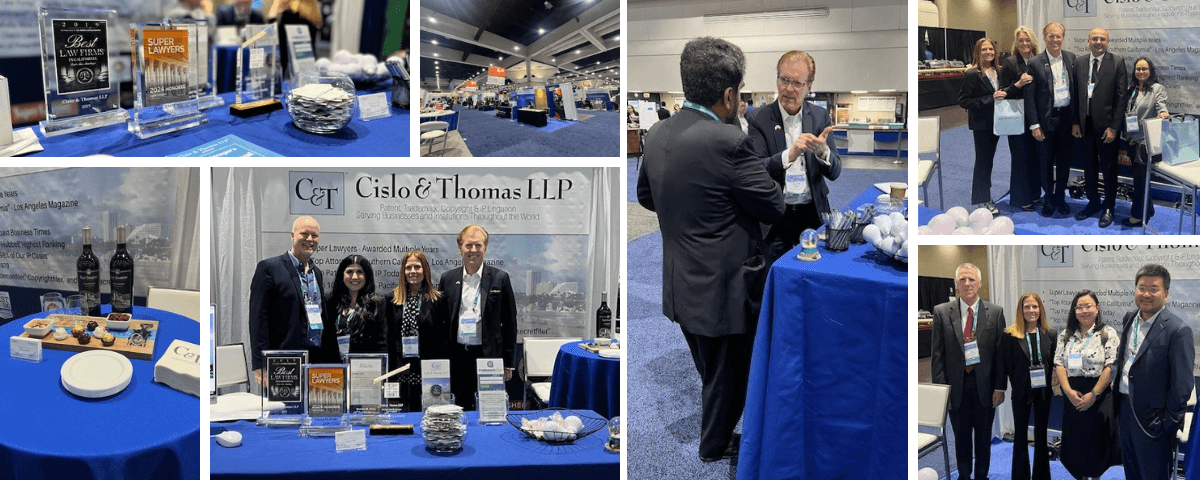
We greatly enjoyed catching up with our international friends and new associates at the 147th Annual Meeting of the International Trademark Association (INTA) in San Diego! This is where we meet with many of our foreign intellectual property associates who file patents and trademarks for our clients throughout the world. It was a great experience being able to exhibit in San Diego, and we plan to do so again next year in London.
Previous Newsletters